









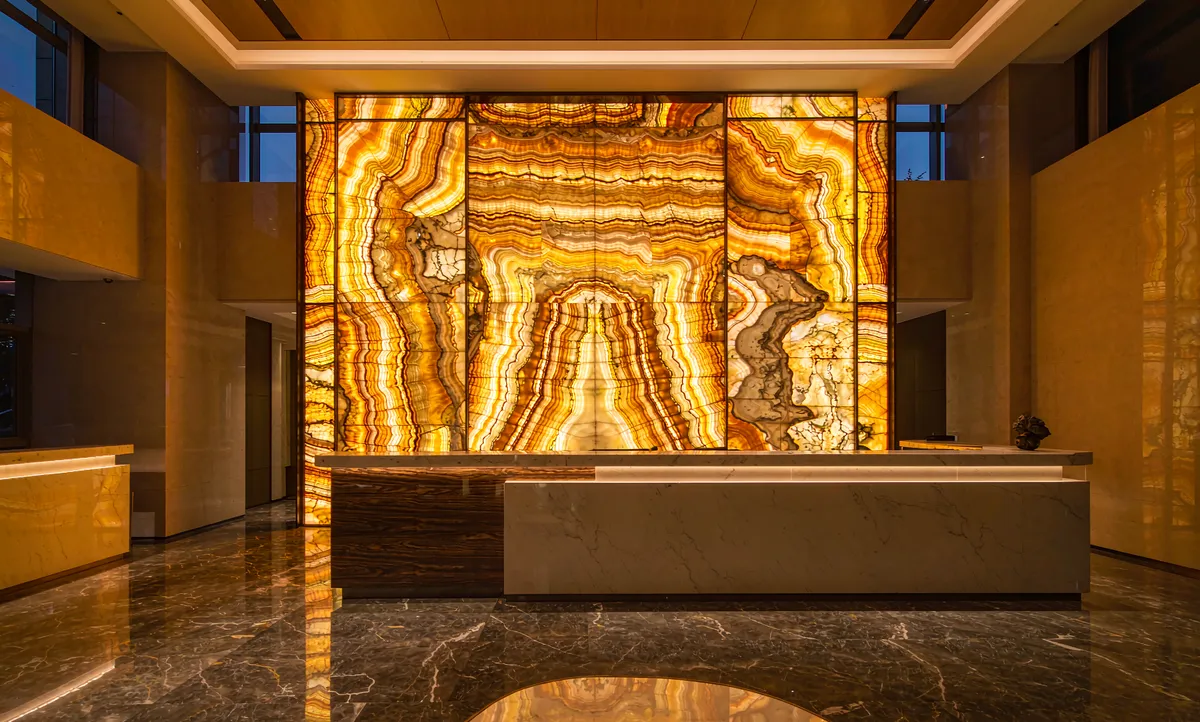
Few materials change a hospitality interior the way backlit onyx does. By day, the panel reads as a polished stone wall with soft banded veining. When the lighting comes on, the same panel glows from within, and the reception desk, bar front, or vanity surround becomes the photograph every guest takes. The effect is dramatic, but it is earned in the specification stage: onyx is one of the most fragile dimension stones in commercial use, and a backlit installation multiplies the number of decisions — slab selection, thin veneer fabrication, lamination, lighting integration, and shipping — that must be right before the panel ever reaches the wall.
This guide is written for designers, purchasing teams, and project managers specifying translucent onyx for hotel and residential projects, whether the panels ship as part of a full stone package or as a standalone feature element.
Onyx is a banded calcite stone formed in caves from mineral-rich spring water, which is why it shows the layered, wavy veining that makes it so distinctive when light passes through. The bands act like a natural diffuser: light entering the back of a slab scatters through the calcite layers and emerges as a warm, even glow rather than a hot spot behind the stone.
Three practical properties follow from this structure, and each one affects the specification:
The classic application. A backlit onyx panel behind the reception counter turns the first fifteen seconds of a guest's arrival into a brand moment. Because the panel is vertical and protected, the fragility of the stone is manageable, and the wall can be divided into several panels that share a matched vein pattern across the run.
Hotel bars and restaurant back bars use onyx panels as a glowing backdrop for bottle displays. Here the stone sits behind glass shelving and lighting, so it faces little direct contact — but the specification should still call for a sealed surface and a detailing plan for the shelf brackets that penetrate or clamp the panel.
In guest bathrooms and spa suites, thin onyx panels laminated to a backing substrate are mounted behind mirrors or as illuminated vanity splashes. The light output needed here is modest, which keeps the LED system simple and serviceable.
Onyx should not be specified for floors, working countertop surfaces, shower floors, or anywhere the panel will take impact, abrasion, or standing water without protection. Backlighting also amplifies every natural characteristic — fissures, resin-filled voids, and banding irregularities become visible shadows. Projects that need the glow but not the maintenance profile should consider the alternatives in the table below.
Slab approval for a backlit project must happen with light behind the stone. Photograph every candidate slab lit from the rear at the same exposure, and number the photographs to match the slab numbers. For panels that will sit side by side, approve slabs as matched sets — neighboring slices from the same block give the most consistent banding across a multi-panel wall.
Bookmatching — opening two adjacent slabs like a mirror image — is the most requested layout for backlit onyx, and for good reason: the symmetry of the veining is doubled by the glow. For longer walls, sequence-matching keeps the banding flowing in one direction across three or more panels. The layout drawing should be approved before fabrication, because once the panels are cut from the block, the sequence is locked.
Onyx almost always contains naturally occurring fissures and voids that the mill stabilizes with resin or mesh backing. These are not defects; they are part of how the stone holds together, and under backlighting they often read as character rather than flaws. The purchase order should define what is acceptable — for example, no open voids on the finished face, resin repairs permitted where they do not interrupt the visual flow — rather than rejecting the material class outright.
Onyx is not the only way to achieve a glowing panel, and for some budgets or performance requirements, an alternative is the better engineering answer.
| Material | Visual effect | Durability | Cost level | Best use |
|---|---|---|---|---|
| Natural onyx (backlit) | Deepest depth; genuine mineral banding | Fragile; needs protected placement | Highest | Flagship lobbies, bars, vanity features |
| Back-painted or textured glass | Clean, even glow; limited pattern | Very good | Medium | Corridors, elevator lobbies, high-touch areas |
| Translucent resin / engineered panels | Consistent pattern, can imitate stone | Good | Medium | Budget-driven feature walls, repetitive rooms |
| LED lightbox with printed film | Full graphic control | Good | Lowest | Retail-adjacent spaces, temporary installations |
Natural onyx wins on depth and authenticity — nothing manufactured reproduces the way mineral banding scatters light — but it carries the highest material, fabrication, and handling cost of the four options.
A full 20 mm onyx slab backlit from behind gives a rich glow but is heavy and, more importantly, unnecessary: light transmission improves as the stone gets thinner. Mills therefore cut onyx into thin veneers — commonly in the 5 to 10 mm range — for backlighting work. Thinner stone transmits light more evenly with less LED power behind it, which reduces both the heat load and the energy consumption of the feature.
Thin onyx cannot support itself, so veneers are laminated at the factory to a backing substrate — glass, ceramic, or a lightweight honeycomb panel. The backing does three jobs: it carries the structural load, it protects the brittle stone during handling, and it gives the installers a fixing edge that does not depend on the onyx itself. The lamination line is the single most important quality gate in the whole process; a poorly bonded panel can delaminate in transit or after installation.
Panel joints should be detailed in the shop drawings before cutting. On backlit walls, a tight, hairline seam keeps the glow continuous; a butt joint that drifts open shows up as a dark line through the light. Edge details — where the panel turns a corner or meets a countertop — are usually finished with a mitered edge so the stone face wraps the return and the backlight bleeds evenly around the corner.
The lighting system is half the specification, and it needs to be engineered with the stone, not after it.
Backlit or not, onyx is a calcite stone with the same care rules as marble. Panels should be sealed at the factory and re-sealed on site after installation, using a penetrating sealer suitable for polished calcite. Guest-facing surfaces should be cleaned with a neutral pH stone cleaner; glass sprays, descalers, and general-purpose bathroom cleaners will etch the polished face. Because most of the panel is vertical and out of reach, maintenance is lighter than a stone floor — but the handover documentation should still name the permitted products, and housekeeping teams should be briefed before the hotel opens.
Backlit onyx panels are high-value, fragile cargo, and the last chance to catch a problem is at the factory. The pre-shipment QC routine should include:
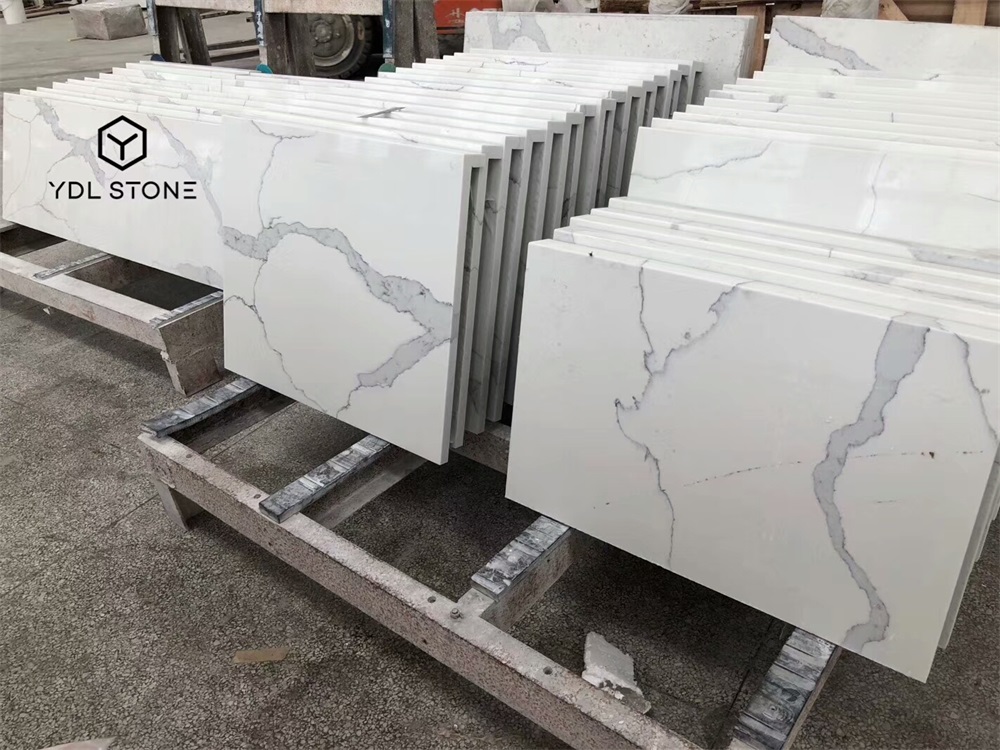
1. Light-box inspection of every finished panel, photographed at fixed exposure, compared against the approved slab set. 2. Lamination bond check — tap testing and edge inspection to confirm the veneer is fully bonded with no voids at the perimeter. 3. Dimension and flatness check against the approved shop drawings, including the position of any cutouts for brackets or outlets. 4. Panel numbering and layout map, so the crating order matches the installation sequence and the site team unloads panels in the right order. 5. Export crating with vibration isolation — panels crated vertically on edge (never flat) with resilient separators, blocked against shifting, and marked fragile on every face. This is the same standard YDL Stone applies to all polished slab shipments, with additional padding for thin laminated veneers.
YDL Stone supplies onyx, travertine, limestone, and quartzite blocks and slabs for hotel and residential projects, and regularly packages backlit onyx features with the surrounding stone scope — vanity tops, wall cladding, and flooring — so the entire container arrives as one coordinated, QC-checked shipment. Send us your drawings, the panel dimensions, and the lighting concept, and our team will propose slab options with light-box photos, a bookmatching layout, and a fabrication plan with firm lead times. Contact YDL Stone to start the specification conversation and request samples from current onyx blocks.
No. Onyx is too soft and brittle for foot traffic, and backlighting a floor adds waterproofing and structural complexity for no visual benefit. Use onyx as a vertical feature and choose granite, quartzite, or dense limestone for the surrounding floor.
Most backlit work uses thin veneers cut in the 5 to 10 mm range, laminated to a glass, ceramic, or honeycomb backing for strength. Thinner stone glows more evenly and needs less LED power, but the exact thickness should be decided with the fabricator based on panel size and the lighting design.
Not when the system is specified correctly. Diffused LED tape runs cool compared with older lighting technologies, and a diffuser panel with proper standoff keeps the stone temperature stable. Heat-generating components such as drivers should be located outside the panel cavity.
Slabs are approved as a set, on a light box, before cutting. Adjacent slices from the same block are reserved for the project, cut in bookmatched or sequence-matched order according to the approved layout drawing, and numbered so the installation follows the same sequence from crate to wall.
It can be, with conditions: the panel must be laminated to a waterproof backing, detailed away from direct spray, and sealed and maintained with calcite-safe products. Many projects prefer to limit onyx to the dry vanity zone and use porcelain or denser stone inside the shower enclosure.
Use a neutral pH stone cleaner and soft cloths only. Avoid glass cleaners, bathroom descalers, vinegar-based products, and abrasive pads — all of them etch polished calcite. Re-seal panels as part of the hotel's periodic stone maintenance program.