
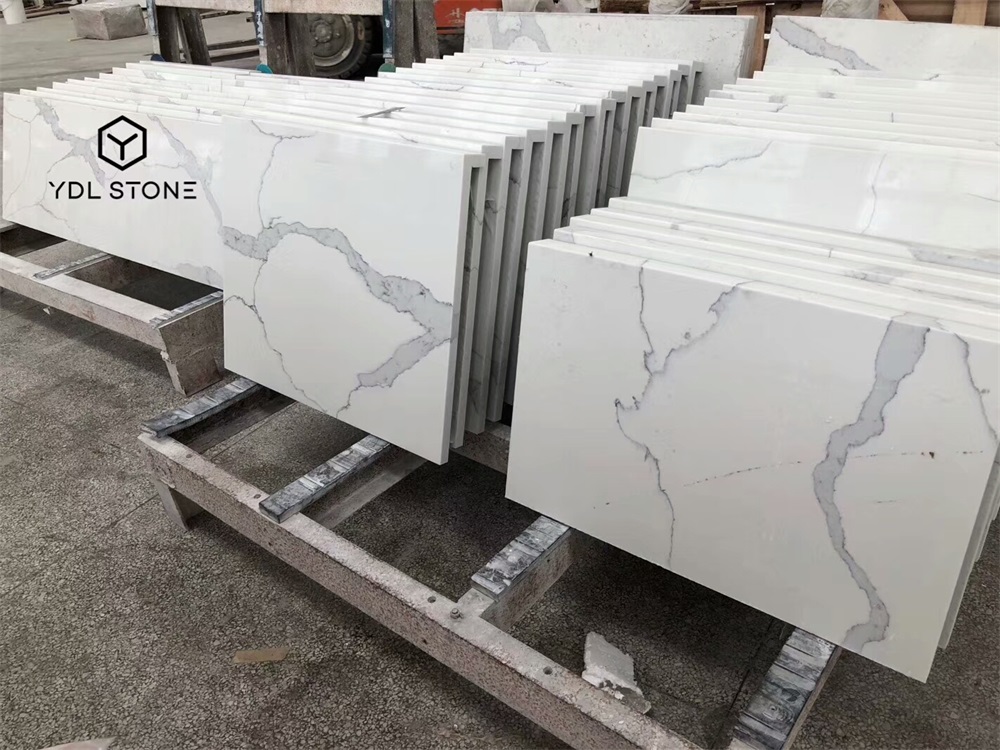









Engineered quartz countertops are manufactured through a highly automated, computer-controlled process that transforms raw quartz aggregate into consistent, durable slabs. Understanding the manufacturing process helps buyers evaluate supplier capabilities, quality control systems, and consistency between shipments. This guide walks through each production stage based on the process used at modern facilities like YDL Stone's Xiamen manufacturing base.
| Step | Process | Quality control |
|---|---|---|
| 1 | Raw material inspection & weighing | Purity testing, supplier traceability |
| 2 | Automated mixing | Computer-dosed ratios |
| 3 | Mold casting | Thickness precision |
| 4 | Vacuum compaction | Density and porosity verification |
| 5 | High-temperature curing | Strength and toughness testing |
| 6 | Polishing | Surface gloss calibration |
| 7 | Final inspection | Color, thickness, defect checks |
The process typically takes 7–14 days from raw material to finished slab, depending on curing time and surface finish requirements.
The process begins with rigorous incoming material control. Natural quartz aggregate is sourced from mines and arrives at the factory in graded sizes. Each batch undergoes:
Visual inspection for foreign materials (organic matter, metal fragments)
Purity testing to confirm quartz content and minimize contaminants
Particle size grading to ensure consistent texture in the finished slab
Moisture content measurement because water content affects resin binding
Resins, pigments, and additives are also inspected upon arrival, with each supplier lot receiving a unique identification number for traceability.
According to YDL Stone's quality protocols, raw material rejection rates above 2% trigger sourcing reviews — a standard aligned with ISO 9001:2015 quality management requirements.
Once approved, raw materials are loaded into computer-controlled mixing systems. The mixing stage is critical because inconsistent ratios produce slabs with variable strength, color, and porosity.
The mixing process introduces:
Quartz aggregate (90–95% of total weight)
Polymer resin (typically unsaturated polyester, 5–10%)
Pigments (iron oxides, titanium dioxide for color)
Additives (UV stabilizers, coupling agents, curing accelerators)
Modern mixing systems dose each ingredient by weight rather than volume, ensuring batch-to-batch consistency. Mixing time and speed are calibrated to the specific formulation — typically 5–15 minutes per batch.
The blended mixture is transferred to casting molds sized for the target slab dimensions. Standard slab sizes are:
3200 × 1600 mm (most common for kitchen countertops)
3000 × 1400 mm (alternative standard)
Custom sizes for specific projects
Molds are pre-treated with release agents and may include reinforcement for thinner slabs (15mm) where structural integrity during curing is critical.
Thickness precision is controlled at this stage. Standard thicknesses include:
15 mm for vertical applications and budget-conscious projects
20 mm for residential kitchen countertops (most common)
30 mm for premium residential and commercial islands
This stage is what differentiates engineered quartz from other cast stone products. After casting, slabs are subjected to vacuum compaction:
Vacuum environment: Air is evacuated from the chamber, typically reaching 30–50 mbar absolute pressure
Vibration: Mechanical vibration (50–60 Hz) consolidates the mixture
Pressure: Compaction forces air out of the matrix, eliminating voids
The result is a non-porous slab with density typically exceeding 2.4 g/cm³. This step is essential for:
Stain resistance: Non-porous structure prevents liquid penetration
Strength: Uniform density eliminates weak points
Hygiene: Smooth surface inhibits bacterial growth
The vacuum compaction process is sometimes called "Bretonstone" after the Italian company Breton S.p.A. that developed and patented the original technology in the 1960s, though similar processes are now used worldwide.
After vacuum compaction, slabs move to curing kilns for thermal processing. The curing cycle typically involves:
Heating phase: Gradual temperature increase to 100–120°C (212–248°F)
Curing phase: Maintained temperature for 1–3 hours to polymerize the resin
Cooling phase: Controlled cooling to prevent thermal stress
High-temperature curing improves:
Flexural strength: Resistance to bending stress during transportation and installation
Toughness: Ability to absorb impacts without cracking
Chemical resistance: Stability against acids, oils, and cleaning agents
Dimensional stability: Resistance to warping or distortion over time
The American Society for Testing and Materials (ASTM) standard C880 specifies flexural strength testing methods used to verify proper curing.
Once cured, slabs move to polishing lines that use progressively finer abrasive heads to achieve the desired surface finish:
| Finish | Process | Gloss level |
|---|---|---|
| Polished | Fine abrasive heads, final buffing | 80–90+ GU (gloss units) |
| Honed | Medium abrasives, no final buffing | 30–50 GU |
| Matte | Coarser abrasives | 10–25 GU |
| Textured | Brushed or sandblasted | Variable |
Polished surfaces are most common for kitchen countertops because they reflect light and highlight veining patterns. Honed and matte finishes have grown in popularity for contemporary designs that minimize glare.
Calibration lines (separate from polishing) ensure slabs are precisely uniform in thickness across the entire surface, typically within ±0.5mm tolerance for premium products.
Every finished slab undergoes final inspection before packaging. Inspection criteria include:
Color consistency: Comparison against master color standards under standardized lighting (typically D65 daylight simulation)
Surface defects: Visual inspection for cracks, chips, pinholes, or color variations
Dimensional accuracy: Length, width, and thickness measurements
Gloss level: Gloss meter readings at multiple surface points
Edge integrity: Inspection for edge chips or damage from handling
Slabs that fail inspection are either reworked (re-polished) or downgraded for non-critical applications. Premium suppliers reject 3–5% of production; top-tier factories maintain rejection rates below 2%.
A quality-focused manufacturer maintains certifications across the production process:
ISO 9001:2015: Quality management system certification, covering all production stages
NSF/ANSI 51: Food contact safety certification, verified annually
GREENGUARD Gold: Low emission certification, verified annually
CE Marking: European conformity for construction products
Each batch of slabs receives a unique identification number traceable through:
1. Raw material supplier and batch 2. Production date and line 3. Quality test results 4. Customer shipment records
This traceability allows quality issues to be investigated back to specific production conditions if needed.
The manufacturing process directly impacts installation and long-term satisfaction:
Consistent thickness: Reduces fabrication time, ensures tight seams
Uniform density: Eliminates weak points that chip during cutting
Color consistency: Allows multiple slabs to appear identical in large installations
Surface calibration: Simplifies installation and edge profile work
Low porosity: Eliminates sealing requirements and reduces staining risk
For large commercial projects requiring dozens or hundreds of slabs, manufacturing consistency becomes the difference between smooth installation and costly field adjustments.
When evaluating quartz suppliers, look for:
1. Vertical integration: Manufacturers controlling raw material sourcing through final inspection 2. ISO 9001:2015 certification: Confirmed by audit, not self-declared 3. Annual third-party testing: NSF, GREENGUARD, SGS reports available on request 4. Factory tours: Reputable manufacturers welcome customer visits 5. Export experience: Logistics and documentation for international shipping
YDL Stone operates two production facilities in Xiamen with full ISO 9001:2015 certification, NSF/ANSI 51 food safety certification, GREENGUARD Gold low emission certification, and CE marking. The manufacturing team supports virtual or in-person factory tours for serious buyers.
How long does it take to manufacture quartz slabs? The full process takes 7–14 days depending on curing time and surface finish complexity.
What is Bretonstone? Bretonstone is the patented vacuum compaction technology developed by Breton S.p.A. in the 1960s. It is the foundation of modern engineered quartz manufacturing.
Are all quartz factories the same? No. Quality varies significantly between manufacturers based on raw material sourcing, process control, and quality management systems.
Can engineered quartz be made outdoors? Most engineered quartz is designed for indoor use. Outdoor applications require UV-stabilized formulations specifically designed for prolonged sun exposure.
What is the difference between quartz factories and brand labels? Some quartz "brands" contract manufacturing to factories. Direct-from-factory purchasing often provides better pricing and quality control.
For buyers evaluating quartz suppliers for ongoing import or distribution, factory visits or virtual tours provide direct visibility into manufacturing capabilities. YDL Stone arranges virtual factory tours via video conference for international clients and welcomes in-person visits at the Xiamen facility.
Schedule a factory tour or request production specifications for your next project.