








The edge profile is one of the most visible design choices in any countertop installation. While many homeowners focus on color and pattern, the edge profile significantly affects the finished appearance, fabrication cost, and overall design character. This visual guide covers the most popular quartz edge profiles and their ideal applications.
Edge profiles serve both functional and aesthetic purposes:
Safety: Rounded or beveled edges are safer than sharp edges, especially in homes with children
Style: Edge profiles range from simple modern lines to ornate traditional curves
Visual weight: Different profiles create different perceptions of thickness and presence
Cost: More complex profiles require additional fabrication time and cost
Cleaning: Some profiles are easier to wipe clean than others
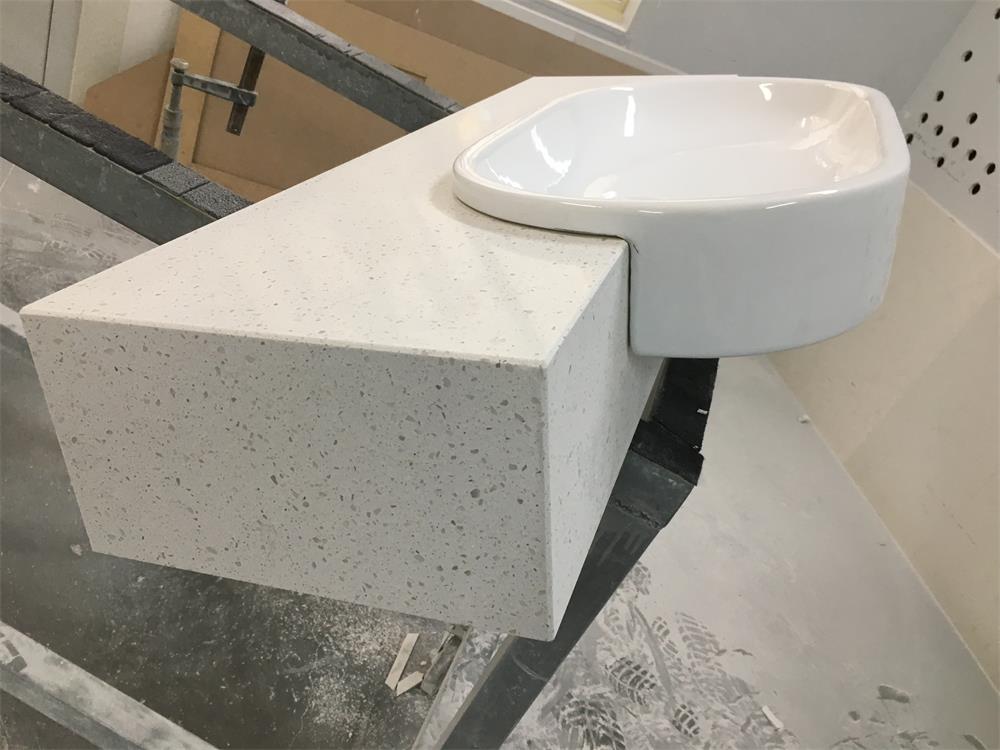
The eased edge is the modern default — a slightly softened 90-degree corner with minimal rounding. It works with virtually any design style and is the most cost-effective option.
Appearance: Clean, modern, minimal
Cost: Baseline (no additional fabrication)
Best for: Contemporary kitchens, minimalist designs
Cleaning: Very easy
Compatibility: Works with all quartz colors and patterns
A beveled edge features an angled cut at the top edge, typically 45 degrees, creating a small flat surface along the top of the edge.
Appearance: Subtle architectural detail
Cost: Low additional cost
Best for: Traditional and transitional designs
Cleaning: Easy — the angled top surface shows dust occasionally
Variations: Standard bevel (small), deep bevel (more dramatic)
The half bullnose rounds the top edge of the countertop, creating a smooth curve from the top surface down to the side. It's softer than an eased edge while maintaining a clean appearance.
Appearance: Classic, friendly, less formal
Cost: Low additional cost
Best for: Family kitchens, traditional designs
Cleaning: Easy — smooth curve allows simple wiping
Note: Can show fingerprints on darker colors due to curved reflective surface
The full bullnose creates a complete semicircular curve from top to bottom of the edge, producing a fully rounded edge.
Appearance: Soft, traditional, substantial
Cost: Moderate additional cost
Best for: Traditional kitchens, country designs
Cleaning: Easy to wipe in one direction
Consideration: Can appear less modern than simpler edges
The ogee is one of the most recognized traditional edge profiles, featuring an S-shaped curve with concave and convex sections. It's ornate and signals premium construction.
Appearance: Formal, traditional, luxury
Cost: Higher additional cost (complex fabrication)
Best for: Traditional kitchens, formal designs, premium homes
Cleaning: Moderate — the curves require wiping in multiple directions
Variations: Standard ogee, deep ogee, demi-ogee
The Dupont features a vertical step at the top followed by a curved lower section, creating a distinctive angular profile.
Appearance: Architectural, transitional
Cost: Higher additional cost
Best for: Transitional designs, formal kitchens
Cleaning: Moderate — the step collects dust occasionally
A waterfall edge continues the countertop material vertically down the side of an island or cabinet run, terminating at the floor. It's not technically an edge profile but a continuation of the slab.
Appearance: Dramatic, modern, premium
Cost: Significantly higher (additional slab material and fabrication)
Best for: Modern kitchens, luxury installations, feature islands
Cleaning: Easy — same as standard vertical surface
Note: Requires book-matching or color-matched slabs
Three small rounded sections stacked along the edge create a subtle decorative profile.
Appearance: Soft traditional, decorative
Cost: Moderate additional cost
Best for: Traditional and transitional kitchens
Cleaning: Moderate
The chiseled edge mimics the natural fractured appearance of broken stone, with irregular, hand-cut looking edges. YDL Stone offers this for natural stone products.
Appearance: Rustic, natural, textural
Cost: Higher additional cost
Best for: Rustic, farmhouse, natural stone designs
Cleaning: Moderate — irregular surface collects more dust
Note: Best suited to natural stone, not commonly used for engineered quartz
Two angled cuts create a more pronounced bevel effect than the standard single bevel.
Appearance: Architectural, distinctive
Cost: Moderate additional cost
Best for: Custom designs, statement kitchens
Cleaning: Easy
Two pieces of slab are joined at a 45-degree angle to create the appearance of a much thicker countertop. This allows economical use of thinner slabs to mimic thicker stone.
Appearance: Substantial, premium, modern
Cost: Higher (additional fabrication and material)
Best for: Modern designs, luxury installations
Cleaning: Easy
| Design style | Recommended profiles |
|---|---|
| Modern minimalist | Eased, small bevel, mitered |
| Contemporary | Eased, half bullnose, small bevel |
| Transitional | Bevel, half bullnose, ogee |
| Traditional | Bullnose, ogee, triple pencil |
| Formal/luxury | Ogee, waterfall, mitered |
| Rustic/farmhouse | Chiseled (natural stone), eased |
| Industrial | Eased, deep bevel |
| Profile | Relative cost | Why |
|---|---|---|
| Eased | Baseline | Standard fabrication |
| Beveled | +5–10% | Simple additional cut |
| Half bullnose | +5–15% | Single curved profile |
| Full bullnose | +10–20% | Complete curve fabrication |
| Triple pencil | +15–25% | Multiple rounded sections |
| Ogee | +20–40% | Complex curve fabrication |
| Dupont | +25–40% | Multi-step profile |
| Mitered | +30–50% | Additional material, joinery |
| Waterfall | +50–100% | Additional slab, edge work |
| Chiseled | +40–60% | Hand-finishing required |
Most kitchens use eased, half bullnose, or beveled edges. Decorative profiles work for islands and perimeter sections in formal kitchens.
Half bullnose or eased edges are most practical — simpler to clean and softer against accidental contact.
The waterfall itself is the profile; the top edge typically remains eased or beveled for comfort and safety.
Edge profiles are typically simple (eased or small bevel) since the focus is on the surface material.
Bullnose or ogee edges add formality to bar installations. Full bullnose is comfortable for resting arms.
Eased edges are standard in commercial applications for durability and cleanability.
For households with young children or elderly residents:
Avoid sharp edges: Bullnose, half bullnose, or eased edges reduce injury risk
Consider rounded corners: Especially at islands where children might run
Skip ornate profiles: Ogee and similar profiles collect more dust and require more cleaning
Prioritize safety: Comfort and safety should outweigh aesthetic preferences
Quality fabricators maintain tight tolerances on edge profiles:
Profile accuracy: ±1/16 inch (1.5mm) deviation from specification
Surface finish: Polished to match the slab surface
Color consistency: Edges should match the slab surface gloss
Seam visibility: Joints at edges should be virtually invisible
YDL Stone coordinates with certified fabricators who maintain these tolerances, ensuring edge profiles meet design specifications.
Edge profiles interact with slab thickness:
| Slab thickness | Profile options |
|---|---|
| 15mm (½ inch) | Eased, beveled, small profiles only |
| 20mm (¾ inch) | All standard profiles |
| 30mm (1¼ inch) | All profiles, including stacked/mitered |
| Mitered (build-up) | Creates appearance of 40mm+ thickness |
For 15mm slabs, decorative profiles like ogee may not be feasible without substrate build-up. 20mm and 30mm slabs accommodate the full range of edge profiles.
Most warranties cover edge profile fabrication defects but exclude damage from:
Impact (dropping heavy objects on edges)
Thermal shock (rapid temperature changes)
Chemical exposure (improper cleaners)
Improper installation (inadequate support)
Quality fabrication protects the warranty. Always use certified fabricators with documented quality systems.
When documenting countertop installations:
1. Photograph at counter level: Shows the profile accurately 2. Include scale reference: A common object for size context 3. Photograph under natural light: Reveals profile curves and finish 4. Capture seam details: Close-ups of seams show fabrication quality 5. Show multiple angles: Different perspectives reveal profile depth
What is the most popular edge profile? The eased edge is the most common choice for modern kitchens, accounting for approximately 60% of installations.
Which edge profile is easiest to clean? Eased edges and half bullnose profiles are easiest to wipe clean with single-direction wiping.
Can any edge profile be used with any quartz slab? Most profiles work with 20mm and 30mm slabs. 15mm slabs have limited profile options without substrate build-up.
Are decorative edges more expensive? Yes. Profiles requiring more fabrication time and complexity cost more than simple eased edges.
Which edge profile works for modern kitchens? Eased, small bevel, and mitered edges are most common in modern designs.
What is the most traditional edge profile? The full bullnose and ogee are the most traditional edge profiles, common in formal kitchen designs.
For designers and homeowners evaluating edge profile options, viewing actual profiles at a fabricator's shop is the best way to make a final selection. YDL Stone works with certified fabricators worldwide who can produce edge profile samples for evaluation.
Contact our design team for edge profile recommendations based on your specific project requirements.