



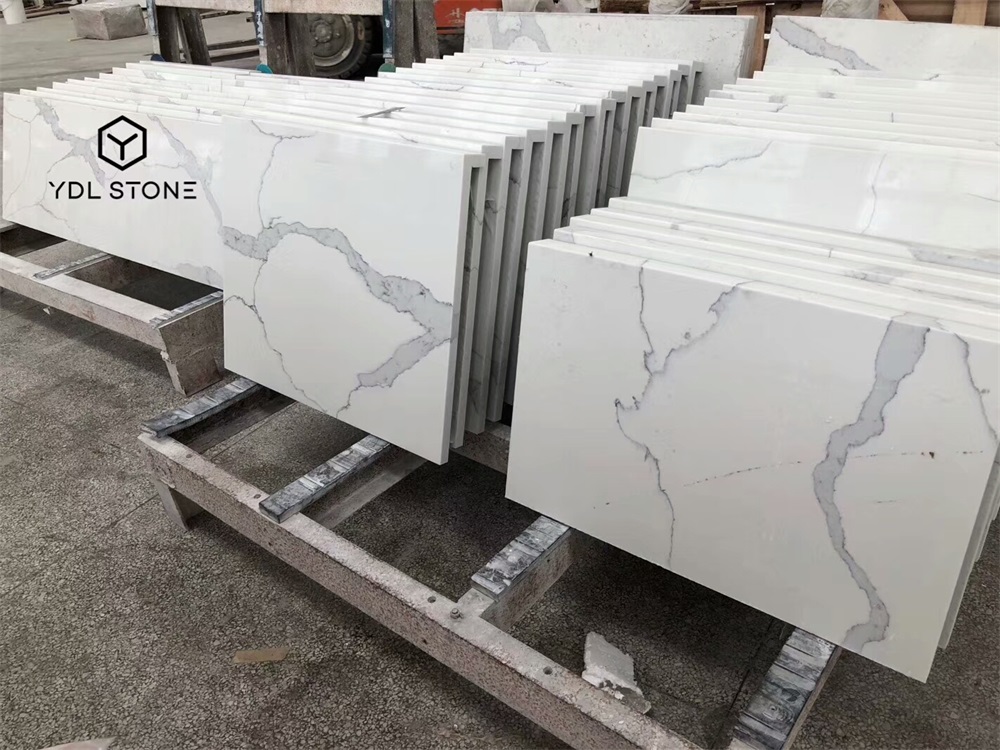










Pre-fabrication slab inspection is critical for avoiding costly surprises during installation. Whether you're a homeowner selecting slabs at a supplier or a contractor verifying delivery, knowing what to look for ensures you receive material that matches your expectations and project requirements.
Slab inspection at the supplier or before fabrication allows you to:
Verify color and pattern: Confirm the slab matches your sample
Identify defects: Catch manufacturing issues before cutting
Plan layout: Optimize cuts based on actual slab characteristics
Document condition: Establish baseline for warranty claims
Prevent waste: Avoid cutting around defects after fabrication begins
Before visiting a supplier or receiving delivery, gather:
Approved samples: The physical samples you selected
Color specifications: Written descriptions or digital images
Project drawings: Layout, seam placement, cutout locations
Specifications: Slab size, thickness, finish requirements
Tape measure: Verify dimensions
Straight edge: Check flatness
Bright flashlight: Reveal surface defects
Color reference cards: Standard lighting comparison
Camera: Document slab condition
Inspect under multiple lighting conditions:
Natural daylight (preferred)
Standard showroom lighting (D65 simulation)
Interior lighting that matches installation location
What to look for:
Uniform color across the slab surface
Consistency with approved samples
Acceptable variation between slabs in the same order
Common issues:
Color banding or streaking
Batch variation between multiple slabs
Discoloration or yellowing in resin
Acceptable variation:
Engineered quartz is designed for color consistency
Slight variation between production batches is normal
Significant variation should be rejected
For solid color series:
Verify uniform color throughout
Check for unexpected particle inclusions
Confirm pattern matches sample
For vein patterns:
Verify vein flow direction
Confirm pattern scale matches expectations
Check for pattern disruption or anomalies
For dual color patterns:
Verify particle distribution
Check for clumping or concentration variations
Confirm secondary tone consistency
Polish quality:
Mirror-like reflection (polished finish)
Consistent gloss level across surface
No visible polishing marks or uneven areas
Honed finish:
Uniform matte appearance
No polishing overspray
Consistent surface texture
Textured finishes:
Uniform texture across surface
No rough spots or smooth areas
Consistent pattern of texturing
Pinpoint defects:
Small dark or light spots
Air bubbles trapped in resin
Contamination from manufacturing
Larger defects:
Cracks or micro-fractures
Chips along perimeter
Deep scratches
Surface anomalies:
Waviness in polished surface
Uneven gloss levels
Visible seams in polishing
Slab edges:
Clean, straight cuts
No chips or spalls
Consistent edge profile
Corner condition:
No broken corners
Square or properly shaped corners
No edge crumbling
Measurements to verify:
Length and width (within ±2mm typically)
Thickness (within ±0.5mm typically)
Squareness (corners at 90° ±1mm)
Flatness (no warping or bowing)
Acceptance criteria:
Confirm with manufacturer specifications
Industry standards vary slightly
Premium products have tighter tolerances
What to check:
Uniform backing
No excessive resin buildup
No mesh reinforcement issues
Manufacturer markings legible
Why it matters:
Backing affects fabrication and installation
Mesh reinforcement indicates structural integrity
Markings provide traceability
Information to record:
Batch/lot number
Production date
Slab sequence number (for multiple slabs)
Color/pattern code
Manufacturer name
Documentation:
Photograph slab identification
Note any visible markings
Cross-reference with order documentation
For projects requiring multiple slabs, additional inspection steps apply:
Verify color match between slabs
Check pattern alignment potential
Plan seam placement based on slab characteristics
Orient slabs for optimal vein flow
Position seams to minimize visibility
Plan cutouts in appropriate slab locations
For vein patterns, book-matching creates symmetrical effects
Identify slabs suitable for book-matching
Mark book-match orientation before cutting
For every slab inspection, document:
Overall slab photo: Full slab visible
Close-up of any defects: Clear documentation of issues
Identification markings: Lot numbers and codes
Sample comparison: Slab alongside approved sample
Inspection date and inspector
Slab identification details
Condition observations
Accept/reject determination
Any corrective action required
Share documentation with fabricator
Provide to customer before cutting
Maintain records for warranty purposes
Cause: Production batch differences, pigment inconsistencies Action: Verify against approved sample; reject if significant
Cause: Air trapped during vacuum compaction Action: Small pinholes may be acceptable; large pinholes require rejection
Cause: Improper handling, curing issues, or thermal stress Action: Reject cracked slabs — cannot be repaired invisibly
Cause: Handling damage during production or transport Action: Small chips may be trimmed during fabrication; large chips may require rejection
Cause: Mixing inconsistencies Action: Usually cosmetic; verify acceptability before fabrication
Cause: Polishing equipment issues or operator error Action: Often repairable; assess before fabrication
Cause: Curing unevenness or polishing irregularities Action: Significant waviness makes fabrication difficult; may require rejection
Color and pattern match approved samples
Minor defects are in non-critical areas
Defects can be avoided during fabrication
Quality meets industry standards
Color or pattern doesn't match samples significantly
Defects are in critical areas (near cutouts, in seam zones)
Multiple defects across slab surface
Dimensional issues affect fabrication
Surface defects cannot be repaired
When defects are found:
Document issues clearly with photos
Reference specific slab identification
Communicate in writing
Allow supplier reasonable opportunity to address
Replacement: New slab from same batch
Credit: Partial or full credit toward project
Discount: Reduced pricing for cosmetic issues
Rejection: Full return and replacement
Original inspection records
Photographic evidence
Communication with supplier
Project impact assessment
YDL Stone implements quality control throughout production:
Raw material verification
Mid-production quality checks
Pre-polishing inspection
Final quality control before packaging
Each slab receives unique identification
Quality records maintained for traceability
Test reports available for specific production batches
Customer-specific quality documentation available on request
Pre-shipment photo documentation
Sample matching verification
Claims handling for verified quality issues
Replacement slabs for verified defects
Industry standards for slab acceptance:
Length/width: ±2mm typical
Thickness: ±0.5mm typical
Squareness: ±2mm
Flatness: ±2mm over 1.5m length
Length/width: ±1mm
Thickness: ±0.3mm
Squareness: ±1mm
Flatness: ±1mm over 1.5m length
Cracks
Large chips
Surface depressions
Visible contamination
Before approving slabs for fabrication, verify:
[ ] Color matches approved samples
[ ] Pattern consistency acceptable
[ ] Surface finish meets specifications
[ ] No critical surface defects
[ ] Edge condition acceptable
[ ] Dimensional accuracy within tolerance
[ ] Slab identification documented
[ ] Multi-slab consistency verified
[ ] Layout planning completed
[ ] Customer approval obtained
What if a slab has minor defects in non-critical areas? Minor defects in non-critical areas can often be worked around during fabrication. Discuss with your fabricator.
How much variation between slabs is acceptable? Some variation is normal. Industry standard allows slight variation between production batches. Significant variation should be rejected.
Can slab defects be repaired? Some defects can be filled or polished out; others cannot be repaired invisibly.
Should I inspect slabs at the supplier or accept delivery? Always inspect before fabrication, whether at the supplier or upon delivery.
What if defects are found during fabrication? Stop fabrication immediately, document the issue, and contact the supplier. Fabrication of a defective slab creates waste.
Who pays for defective slabs? Quality defects are typically the supplier's responsibility. Document carefully and communicate promptly.
For buyers verifying quartz slab quality before fabrication, YDL Stone provides pre-shipment photos, quality documentation, and claims support for verified defects.
Request quality documentation or contact our quality team for inspection guidance and claims support.