









Limestone rarely gets the attention that marble and quartzite attract, yet it is the quiet workhorse of hotel and residential construction. It clads facades, paves lobbies, lines bathrooms, and does so with a softer, more uniform character than most stones can offer. It is also the category where buyers are most often surprised — sometimes pleasantly, sometimes not — because "limestone" on a quotation can describe materials that behave very differently on a building site.
This guide sets out the main limestone varieties you will meet in export trade, explains what density and absorption figures actually tell you about a stone, and matches each type to the applications where it performs best — plus the checks worth making before your order leaves the factory.
Three properties explain limestone's staying power in commercial work.
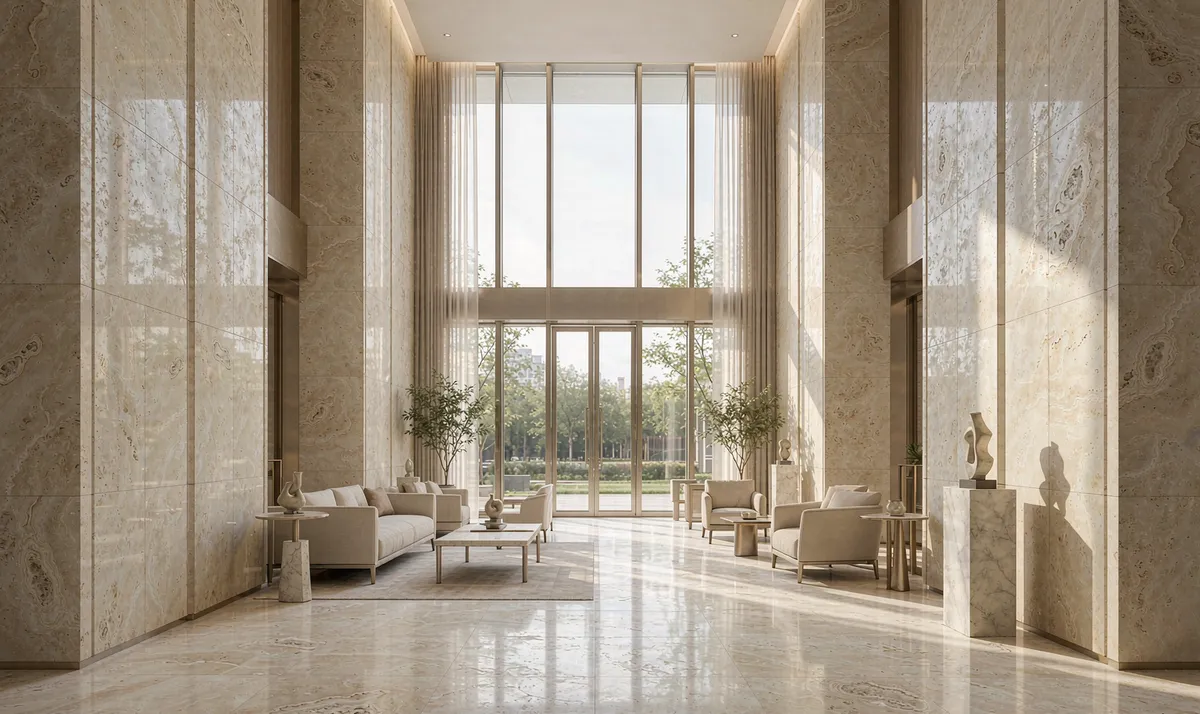
Visual calm. Limestone tends toward even, low-contrast tones — creams, beiges, greys — with fine grain and few dramatic veins. In a hotel lobby or a residential development with hundreds of square metres of surface, that consistency is a design asset: large areas read as one calm plane instead of a patchwork.
Workability. Limestone is softer on the saw than siliceous stones, which means cleaner profiles, crisp banding, detailed cornices, and economical cut-to-size production. Much of the classical stonework vocabulary — mouldings, quoins, balustrades — exists because limestone accepts that fabrication.
Availability in large, matched quantities. Limestone deposits are typically extensive and stratified, so a project can draw consistent material across many containers and many months of construction. For phased hotel or residential builds, batch-to-batch continuity matters as much as the stone's own appearance.
The trade-off is real, though. Limestone is calcite-based, so it is acid-sensitive, and the more porous varieties demand honest specification and disciplined maintenance. That is why the next section matters more for limestone than for almost any other stone.
Trade names vary by quarry and country, but export limestone falls into a handful of geological types. Knowing the type tells you more than the label on the crate.
Tight, homogeneous material with low visible porosity and a smooth honed finish. This is the premium tier for flooring and interior cladding: it takes a crisp arris, resists soiling in heavy-traffic areas, and photographs evenly. It is also the tier where consistency commands a price — expect the quarry to sort blocks by shade, and expect shade batches to be declared on the packing list.
Contains visible shells, fossils, or bioclastic fragments set in a finer matrix. The fossil figure gives panels a subtle natural decoration and works well on feature walls and bathroom surfaces. Mechanically it is usually sound, but fossil shells can pop out during honing or weathering, leaving small pits. On exterior work, confirm that open fossil voids are acceptable to the design intent, or specify filling.
Composed of tiny spherical grains cemented together, giving a slightly sugary texture. Classic European building stones are largely oolitic, and the type is well proven in facades. The grain structure means it can absorb somewhat more water than dense varieties, so freeze-thaw performance and sealing become specification points rather than afterthoughts.
Softer, more porous material, sometimes with pronounced bedding bands. Close to the porous end of this group sits travertine — a chemically related stone frequently quoted alongside limestone. These stones deliver warm character at attractive cost, and they reward buyers who specify filling, sealing, and application carefully. They are best in interiors, covered outdoor areas, or mild climates, rather than exposed freeze-thaw facades.
Two figures describe limestone better than any brochure: bulk specific gravity (density) and water absorption. Both come from ASTM C97, the standard test method for absorption and bulk specific gravity of dimension stone, and any professional supplier should be able to provide current test values per stone type.
As a broad frame — not a substitute for actual test reports — construction limestone commonly falls between roughly 2.0 and 2.7 g/cm³ in bulk density, with absorption ranging from under one percent in dense varieties to several percent in open-textured ones. What the figures mean in practice:
| Indicator | What it suggests | Practical consequence |
|---|---|---|
| Higher density, absorption under ~1% | Tight pore structure | Suitable for heavy-traffic floors, exterior cladding in most climates; soiling and staining risk lower |
| Mid-range density, absorption ~1–3% | Moderate porosity | Sound for interiors and sheltered exteriors; sealing and maintenance plan required |
| Lower density, absorption above ~3% | Open pore structure | Interiors, dry climates, or protected areas; specify filling and sealing; verify freeze-thaw if used outside |
| Stated flexural strength (ASTM C880) | Resistance to bending | Matters for thin panels, anchors, and cladding spans |
| Compressive strength (ASTM C170) | Load capacity | Matters for stairs, sills, and structural elements |
Two cautions when reading a supplier datasheet. First, ask whether values are quarry-average or worst-case: a single hero number can hide wide batch variation. Second, ensure the tested material is the same variety, finish, and thickness you are buying — data from a dense sibling variety proves nothing about the open-textured stone in your container.
| Application | Best-suited limestone type | Watch-outs |
|---|---|---|
| Hotel lobby flooring | Dense fine-grained | Abrasive wear dulls honed finish; plan repolishing cycle |
| Residential interiors, floors and walls | Dense or fossiliferous | Confirm shade batches across rooms |
| Bathroom vanities and shower walls | Fossiliferous, dense | Acid-sensitive; specify pH-neutral care |
| Exterior facade cladding | Dense or oolitic, verified freeze-thaw | Anchor design, thermal movement, salt environments |
| Feature and feature-lit walls | Fossiliferous, banded | Fossil pits may read as defects under raking light |
| Pool surrounds and coastal projects | Dense varieties only, with sealing | Salt attack and chlorine are hard on porous limestone |
| Stairs, sills, and copings | Dense, higher compressive strength | Edge profiles lose sharpness faster than granite |
The facade line deserves emphasis. Limestone has an excellent track record as a cladding material, but success depends on the system behind it: ventilated or drained cavities, mechanical anchorage appropriate to the panel size, and — in coastal or de-icing-salt environments — a hard look at salt weathering before the stone is chosen. Where freeze-thaw is part of the service environment, ask for freeze-thaw test results (for example, the method described in EN 12371, or ASTM freeze-thaw procedures) for the specific variety, not the family.
Limestone disputes are usually specification disputes. A few lines in the purchase order prevent most of them:
Honed is the default finish for limestone and the right one for most interiors: it keeps the matte, calm character while opening the colour. Polished limestone exists but reads more like marble and shows etching more obviously. Brushed and sandblasted finishes suit exterior paving and add slip resistance, in line with the slip standards discussed in our earlier flooring guide.
Because limestone is calcite, acid is the enemy — descalers, vinegar-based cleaners, and acidic grout products will etch the surface. Specify pH-neutral maintenance from day one, and brief the cleaning contractor before handover, not after the first etch marks appear. Edge details should account for the stone's grain: very thin arrises on softer varieties chip more readily than on granite, so a small chamfer or a slightly softened edge survives transport and life better than a knife edge.
Limestone's workability cuts both ways in the factory: it fabricates fast, which means rushed or damaged pieces are also possible. At inspection, check thickness and flatness against tolerance, sight bundles for shade consistency, and look at honed faces under raking light for fabrication scratches. Confirm crates use foam or board separation between faces — soft stone scratches against soft stone — and that A-frames or bundles are packed per the export crating standard you agreed. Ask for the physical test report to travel with the shipping documents so it reaches the project consultant.
Is limestone weaker than granite? Generally yes — limestone is softer and more acid-sensitive, and usually shows lower compressive and flexural strength than granite. But "weaker" is relative: properly selected dense limestone has served facades and floors for centuries. The right question is whether the specific variety's test data suits your application.
How does limestone differ from travertine? Travertine is a chemically precipitated stone with a characteristic pitted, banded structure; limestone is a broader category of sedimentary stone, usually denser and more uniform. Travertine is often quoted alongside limestone and shares its acid sensitivity. Porous, banded limestones can sit visually close to travertine, which is why test data and honest photographs matter more than category labels.
Can limestone be used outdoors in cold climates? Some varieties, yes — if absorption is low and freeze-thaw performance is verified by test for that stone. Open-textured varieties can suffer spalling in freeze-thaw cycles. Ask for freeze-thaw test results for the exact variety before specifying it for an exposed facade or paving in a cold region.
Does limestone need sealing? Dense varieties used indoors often perform well with minimal treatment, but sealing is inexpensive insurance and is strongly recommended for bathrooms, kitchens, and any exterior use. Use a penetrating impregnating sealer and reapply per the manufacturer's schedule.
What finish is best for limestone floors in a hotel? Honed is the standard: it preserves the matte character and wears gracefully, and a periodic repolishing cycle restores the surface. Highly polished limestone shows etching and traffic patterns sooner in heavy-traffic areas.
What should I ask a supplier before ordering limestone? Ask for the quarry and variety by name, current ASTM C97 density and absorption data (and C880 flexural strength where relevant), shade-batch continuity in writing, the filling policy for pits and voids, and bundle photographs before shipment. A supplier who answers these cleanly is a supplier who knows their material.
Limestone rewards buyers who specify by data rather than by label: choose the variety for the application, verify density and absorption for the exact stone, and put finish, filling, and batch-continuity terms in the order. Do that, and limestone delivers one of the best cost-to-character ratios in natural stone.
YDL Stone supplies limestone alongside travertine, onyx, and quartzite in blocks, slabs, and cut-to-size work for hotel and residential projects, with test data, shade batches, and inspection records documented before every shipment. Send us your drawings, quantities, and finish requirements, and our team will recommend the limestone variety, finish, and packing specification that fit your project schedule.